Options / Contract research
Options flow alerts: observed transactions do not reveal trader intent
Separate an observed trade, inferred grouping, opening exposure and a directional recommendation when reviewing unusual-options activity.
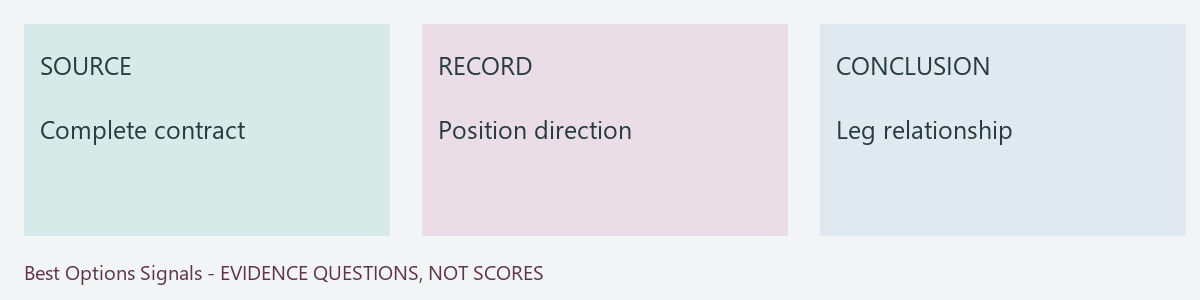
What was actually observed?
An activity event can identify a contract, transaction price, size and timestamp under its feed convention. It may not identify the beneficial trader, pre-existing hedge or intended holding period. Preserve the original fields and which conclusions are inferred. An impressive gross premium is not by itself a forecast.
Public payoff exploration and flow analysis are distinct functions. A modelled structure can illustrate one interpretation without proving that an observed print was that strategy. Do not advertise a complete opening position merely because several transactions appeared close together.
Opening and closing are separate questions
A transaction may open, close, roll or hedge other exposure. Without the relevant original account evidence, that intention can remain unknown. An inference about buying at the ask also depends on accurate contemporaneous quotes and does not settle the full position or the ultimate outcome.
The absence of a visible later close does not prove a winning hold to expiry. A complete signal-performance claim must define the instruction and endpoint, not borrow the observed trader's unknowable decisions. Record any ambiguity rather than filling it with a bullish or bearish certainty.
Keep flow and price-reaction evidence distinct
A subsequently favourable underlying move is not proof that the observed options transaction made money. Premium, time, volatility, closing quantity and costs matter. A chart annotation can preserve an event but is not a subscriber execution record.
Do not claim unseen institutional ownership or insider knowledge from activity size. A large print can serve several purposes. The responsible consumer question is what the selected tool measures and how it discloses inference, not whether a dramatic event guarantees a direction.
A useful review can end with unknown intent
Require exportable event fields, quote context, grouping rules, latency convention and amendments when evaluating a flow tool. If the source sells a ranking or probability, request its method separately. This edition did not operate a paid flow feed or measure event accuracy.
A documented display may still be useful for generating questions. Keep that research value separate from an alleged profitable call. A neutral unresolved state is more informative than a confident conclusion with no account evidence.
Completed fictional case
Fictional feed shows ten call contracts at premium 3, multiplier 100: gross transaction premium is 3,000. It provides no opening/closing flag or parent position. The same print could close an earlier long or form part of a hedge; this review cannot choose which. A later underlying rise therefore does not establish the trader's profit, a fresh buy signal or a 3,000 risk allocation suitable for a reader.
| Object | Declared finding | Evidence boundary |
|---|---|---|
| Observed premium | 10 x 3 x 100 = 3,000 | Transaction magnitude |
| Trader intention | Unknown | No parent account |
| Subscriber outcome | Unknown | No instruction/fills |
Originating references
Public sources inspected 12-13 October 2026. Worked cases are original fiction. No paid tool, account, option-chain feed, selected copying leader or broker route was operated in this review.