Options / Contract research
Option midpoints, combo quotes and attainable net fills
Carry bid, ask, quote size and timestamps into an options alert review; a theoretical midpoint is not a completed spread execution.
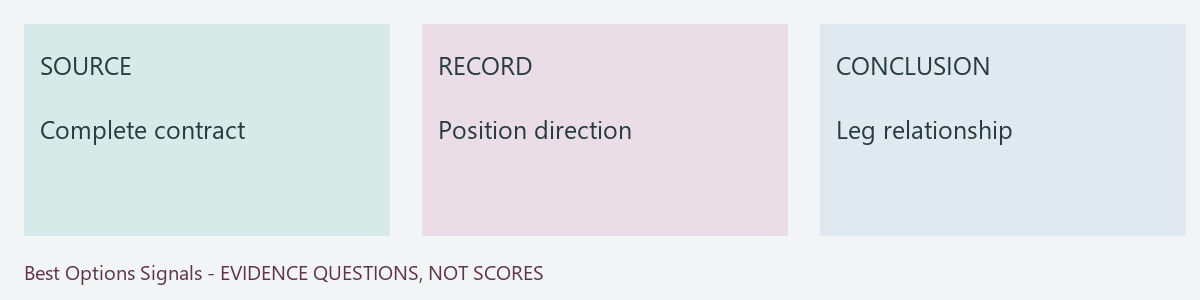
Name the price convention
An alert can publish a mark, last trade, midpoint, limit or actual fill. They are different objects. Preserve which side of each quote a buyer would need, the available size and the quote time. A stale last trade can be especially misleading for an inactive strike.
For a multi-leg instruction, record whether the premium is a net debit or net credit, per spread or whole quantity. Do not add prices from different times into an apparent executable combo. A theoretical sum of leg marks is a calculation, not confirmation that the order book offered the whole structure.
Compare the instruction with the order
Retain the parent order identifier, requested quantities and ratio, limit, amendments and any broker acknowledgement. A successful submission does not establish execution. Fill reports should identify what actually filled and when. Unfilled remainder and rejected orders belong in the population instead of disappearing from the record.
The order-type reference establishes broad mechanics, not the behaviour of a particular options venue or broker. Document the selected routing and complex-order rules separately when an attainable-fill claim depends on them. No latency or price-improvement benchmark is measured by this desk research.
Calculate the difference in money
A small premium change becomes a different monetary commitment after multiplier and quantity. Keep the cost line outside the quoted premium unless the source explicitly includes it. Be clear whether the comparison is entry slippage, exit slippage, or combined friction; do not deduct the same charge twice.
A midpoint-based backtest and a subscriber cash record can differ without either being algebraically wrong. They answer different questions. The reviewer should show both conventions and explain what remains unknown, rather than presenting the favourable convention as the account result.
Keep rejected observations visible
An expired quote or absent size can make an instruction ineligible under a declared execution rule. Record the reason and the parent inventory row. Do not rewrite the entry after the price improves unless the original policy authorised that update and its chronology survives.
A conservative chosen assumption is still an assumption. It cannot replace the actual fill or prove that every other user received a worse price. Our completed case isolates one stated discrepancy, not a measured distribution of broker execution quality.
Completed fictional case
Fictional two-contract debit spread uses multiplier 100. The published entry mark is 1.80, while the recorded fill is declared as 2.10. Closing cash premium is 2.40 and combined costs are 8. Mark arithmetic yields (2.40 - 1.80) x 200 - 8 = 112; fill arithmetic yields (2.40 - 2.10) x 200 - 8 = 52. The difference is 60, not a new source of profit. A partial leg fill would require another state ledger.
| Object | Declared finding | Evidence boundary |
|---|---|---|
| Published-mark convention | 112 net | Hypothetical entry |
| Declared-fill convention | 52 net | Fictional execution |
| Entry difference | 60 | 0.30 x 200 |
Originating references
Public sources inspected 12-13 October 2026. Worked cases are original fiction. No paid tool, account, option-chain feed, selected copying leader or broker route was operated in this review.