An Options Roll Is a New Position Decision
Trace closing legs, opening legs, premium, expiry and assignment exposure instead of treating a roll as an erased losing trade.
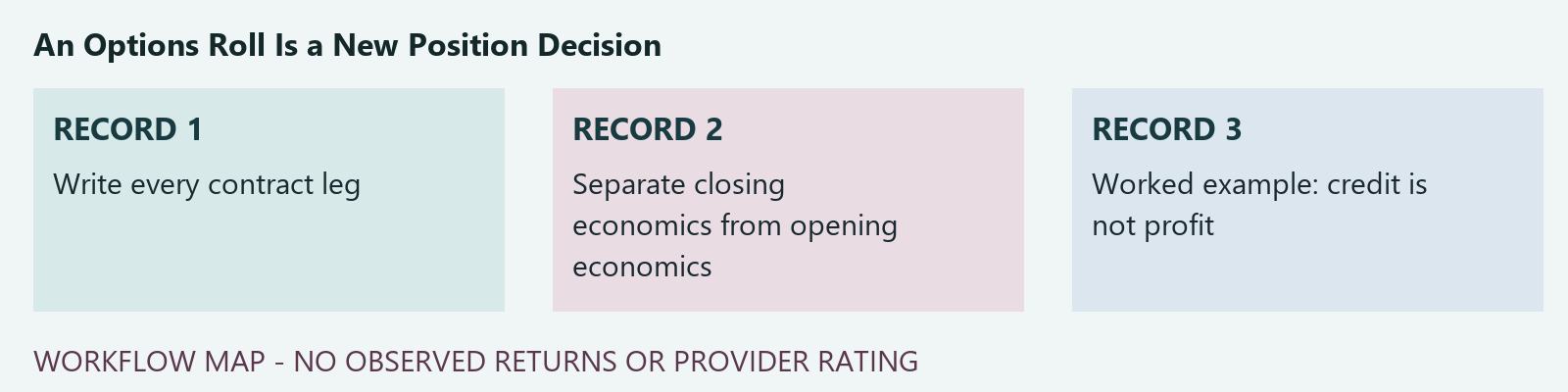
Write every contract leg
Identify underlying, expiration, strike, put or call, exercise style, multiplier and quantity. Record whether each instruction opens or closes a leg. Similar ticker text can conceal different expirations or adjusted contracts. A roll needs the old position and the new position described together; a net credit alone cannot identify either one. Keep the provider instruction, exchange contract details and broker confirmation as distinct records. This chapter does not infer current specifications or market coverage for any listed subscription.
Separate closing economics from opening economics
The close realises an outcome on the existing position. The new open creates fresh exposure, premium and future obligations. Record each fill and fee before aggregating cash flow. A positive net credit can coexist with a loss on the closed position and increased risk on the replacement. Do not restart the historical performance ledger at the roll to hide the earlier loss. A position-family ID can retain continuity while the individual contract IDs change.
Worked example: credit is not profit
Invent a short option sold for 2 premium units and later bought back for 5. Before fees and multiplier, the closed leg loses 3. Selling a replacement for 6 creates 6 units of new premium cash flow, so the combined buyback-and-new-sale cash movement is a 1-unit credit. That credit does not erase the 3-unit realised loss or value the open liability. The example is deliberately simplified and fictional. Account economics require contract multiplier, all fees, replacement valuation and the eventual close or settlement.
Inspect time and assignment exposure
Changing expiration changes the interval over which obligations can arise. Changing strike or quantity changes the exposure as well. OIC materials are the primary reference for exercise and assignment mechanisms; actual contract terms and broker procedures must be checked for the position. A strategy described as a spread still needs a record of both legs and what happened if one was assigned or closed earlier. Do not infer matched assignment timing or a guaranteed broker response from a payoff diagram.
Do not let a stop stand in for payoff analysis
An intended stop is an execution instruction, not a contractual bound on every account outcome. Write the planned close condition, order type and response to unavailable liquidity separately from the contract payoff. SEC order guidance helps define the execution limitation, while the option specifications define the instrument. A change made after a stop or assignment event is a new recorded decision, not a retrospective improvement to the original instruction. Keep the model convention distinct from the subscriber's actual leg fills.
Review the whole position family
A complete options review follows the original open, partial changes, rolls, closing fills and exercise or assignment events through the final account state. Publish which return denominator was used and how open liabilities were valued at reporting boundaries. Do not rank a service using premium collected while omitting repurchase costs or remaining exposure. This workflow supplies no paid-provider trial or subscriber-profit conclusion. Its goal is leg-level accountability: a reader can trace each reported result to the contracts and economic events which produced it.
Decision record
| Question | Record to retain | Decision boundary |
|---|---|---|
| Old position | Every closing leg, fill and cost | A new credit cannot erase a realised loss |
| Replacement | New contracts, quantities and opening fills | A roll creates fresh exposure |
| Assignment | Exercise style and broker-side position event | A spread label is not a complete settlement record |
| Reported outcome | Full family ledger and open-liability valuation | Premium collected is not net account profit |
Blank working record
The worksheet contains column headings only. Enter your own dated observations, keep absent evidence marked unknown, and do not treat the file as certification.
 Download worksheet (CSV)
Primary references
These documents support mechanisms and source definitions, not a tested trading result or a recommendation. Accessed 9 October 2026. The decision workflow and invented examples above are editorial exercises.
Keep reading
Publication methodology | Working glossary | Source and correction policy
Keep the old loss visible
Fictional old position opened for a 2 debit and closes for 1.20 on one contract multiplier 100, realising -80 before costs. A replacement opens for a 1.50 credit; that is new cash with an open obligation, not immediate recovery of the old loss. At the declared later 0.40 close it realises +110 before costs.
Across both completed declared lifecycles the cash is 30 before total costs. With total known costs 8 it is 22. Prior to closing the replacement, the complete result remained open. Grouping the campaign does not erase the first -80 or justify calling the second opening credit profit.